1. Rapid Summary
Maslow’s Hierarchy of Needs is a motivational and behavioral framework that prioritizes human needs along a pyramid structure. In the context of the NCLEX, Maslow is used to guide clinical prioritization by establishing that basic physiological survival needs must be met before a client can address higher-level psychological or emotional concerns. When a client is experiencing multiple concurrent problems, this framework helps the nurse determine which vulnerability threatens life most immediately.
2. High-Yield Points/Must Know
| Hierarchy Level | Clinical Focus & NCLEX Priority |
|---|---|
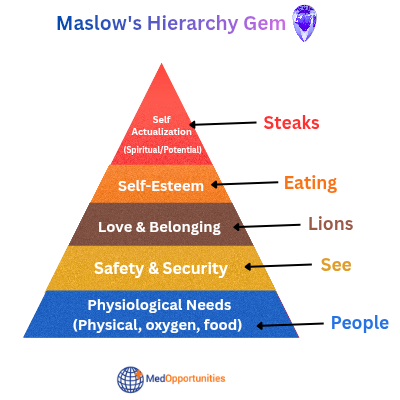
| 1. Physiological Needs | Highest Priority. Survival fundamentals: oxygen, water, food, elimination, temperature control, sleep, and pain relief. |
| 2. Safety & Security | Second Priority. Protection from physical harm, falls prevention, maintaining infection control, and psychological stability/predictability. |
| 3. Love & Belonging | Third Priority. Social support systems, family integration, meaningful relationships, and preventing social isolation. |
| 4. Self-Esteem | Fourth Priority. Sense of worth, personal accomplishment, autonomy, control over care, and body image acceptance. |
| 5. Self-Actualization | Lowest Priority. Achieving personal potential, spiritual growth, and maximum independence. |
3. Mnemonics
Remember the phrase "People See Lions Eating Steaks" to reconstruct the pyramid from the bottom up (highest priority to lowest priority):
4. Most Tested Facts
The Baseline Rule: Physiological Overrides All:
If a question lists one option containing a physiological threat (e.g., altered vital signs, fluid imbalance, airway compromise) and three options containing psychological, educational, or emotional needs, the physiological choice always wins.
Scenario A: A client diagnosed with severe clinical depression refuses to attend group therapy because they are actively vomiting.
Priority Action: Address the vomiting and fluid status (Physiological) before forcing therapeutic communication (Love/Belonging/Esteem).
Scenario B: A client is crying hysterically due to a new amputee status and their residual limb dressing is saturated with bright red blood.
Priority Action: Apply direct pressure and check the pulse (Physiological/Circulation) before providing emotional coping support (Self Esteem/Psychological).
The Exception within Safety:
While psychological safety is important, physical safety (e.g., keeping a suicidal client on 1-to-1 observation or clearing a cluttered floor for a blind patient) sits directly on the border of physiological survival and takes immediate precedence over standard emotional needs.
5. Clinical Correlation
The nurse on a psychiatric unit is formulating a care plan for a client admitted with a severe, acute manic episode related to bipolar I disorder. The client is pacing rapidly, singing loudly, has not slept for 48 hours, and has refused all meals and fluids for the last two days.
- Wrong Action: Prioritizing a nursing goal that focuses on getting the client to socially interact appropriately with peers during group activities (Love & Belonging), or teaching them about medication compliance (Self-Actualization).
- Correct Action: Prioritizing high-calorie finger foods, scheduling mandatory dark-room rest periods, and monitoring hydration status. Because sleep, food, and water are foundational physiological needs, the client is at risk for cardiovascular collapse due to pure physical exhaustion if these baseline markers are not stabilized first.
6. Frequently Tested
- Pain as a Physiological Need: Severe, acute pain can alter vital signs (causing tachycardia and hypertension) and disrupt physical function. The NCLEX recognizes pain control as a foundational physiological need, placing it higher in priority than client education or social concerns.
- Anxiety Interventions: If a client is experiencing a panic attack, their anxiety level is so high that they cannot process teaching. According to Maslow, you must provide basic safety and physiological stabilization first: stay with the client, use short/simple commands, and coach them through slow, deep diaphragmatic breathing.
- New Diagnoses & Discharge Teaching: The NCLEX often asks when to initiate complex discharge teaching. A client who was just informed 10 minutes ago that they have terminal cancer is experiencing a massive disruption to their psychological safety. You cannot successfully implement a self-actualization task (teaching) until their immediate emotional safety and coping baseline are stabilized.
7. Common NCLEX Trap
- Trap: Choosing an option that focuses on building the client's self-esteem or independence when they are in physical distress.
- Reality: False. If a client has an indwelling urinary catheter and is in pain due to bladder distension, do not select an option like: "Encourage the client to self-catheterize to foster independent self-care habits." Flush the line or resolve the blockage immediately to satisfy the physiological elimination need.
- Trap: Assuming all options containing psychological terms are automatically wrong.
- Reality: If all four answer choices are purely psychological, emotional, or educational (meaning no physiological options are present), you must then use Maslow's hierarchy to rank them against each other. Choose Safety/Security first, followed by Love/Belonging, then Esteem.
- Trap: Prioritizing the collection of a client's social or spiritual history during an acute medical admission.
- Reality: False. Spiritual assessments and family history take a back seat when a client is checking in with chest pain or an asthma attack. Secure the airway and vitals first; complete the holistic history elements once the patient is stable.
8. Mini Questions
Question 1: The nurse is preparing a nursing care plan for an elderly client who lives alone and was admitted for severe dehydration and malnutrition. Using Maslow’s Hierarchy of Needs, which nursing diagnosis holds the highest priority?
A. Risk for Loneliness related to lack of local social support systems.
B. Deficient Fluid Volume related to inadequate oral intake.
C. Readiness for Enhanced Knowledge regarding balanced dietary selections.
D. Situational Low Self-Esteem related to loss of functional independence.
- Answer: B
- Explanation: Deficient Fluid Volume directly threatens physiological survival. According to Maslow, physiological survival needs (fluid, nutrition, oxygen) must be resolved completely before the nurse can address safety, social needs (Option A), education (Option C), or self-esteem (Option D).
Question 2: A client with obsessive-compulsive disorder (OCD) is pacing the hallway and continuously washing their hands, causing severe skin cracking. The client is scheduled for a mandatory educational group session in 15 minutes. Which action should the nurse take first?
A. Force the client to stop washing their hands and escort them to the group room immediately.
B. Inspect the client's hands for signs of bleeding or infection and apply a protective emollient barrier.
C. Teach the client alternative cognitive behavioral coping strategies to eliminate the compulsion.
D. Inform the client that they will lose privileges if they do not attend the session.
- Answer: B
- Explanation: Inspecting the hands and treating skin breakdown addresses an immediate physiological and safety need (skin integrity/infection prevention). Forcing the client immediately into a social/educational setting (Option A or C) ignores their active distress and immediate physical safety vulnerability.
Question 3: The nurse is prioritizing care for four clients on a behavioral health unit. Which client requires the most immediate intervention by the nurse?
A. A client who refuses to eat lunch because they believe the kitchen staff is attempting to poison them.
B. A client who is requesting to call their estranged sibling to apologize for a past conflict.
C. A client with borderline personality disorder who states they feel empty and unappreciated by the staff.
D. A client who is standing near the nursing station stating, "I can't breathe, my chest feels like an elephant is sitting on it."
- Answer: D
- Explanation: Option D describes an acute cardiac/respiratory emergency, which represents a critical threat to the fundamental physiological level (Airway/Breathing/Circulation). The other options represent safety/paranoid delusions (Option A), love/belonging needs (Option B), and self-esteem issues (Option C), which are all lower-priority tiers compared to a life-threatening physical crisis.
Question 4: A client newly diagnosed with type 1 diabetes mellitus is weeping and states, "I will never be able to live a normal life again with this disease." The nurse needs to complete mandatory carbohydrate counting and insulin administration education before discharge. Which action should the nurse take next?
A. Hand the client a detailed textbook on diabetes management and leave the room.
B. Sit with the client, validate their feelings, and allow them time to express their grief.
C. Begin the structured slideshow presentation on insulin injection sites immediately.
D. Tell the client that crying will not solve their medical problems.
- Answer: B
- Explanation: The client is experiencing an acute emotional response that threatens their psychological safety and self-esteem. According to Maslow, effective learning (Self-Actualization) cannot occur while a client is in an emotionally unstable state. The nurse must first acknowledge and stabilize their emotional safety before trying to teach technical skills.
Question 5: The nurse is reviewing the care priorities of a client who has a spinal cord injury. Which goal satisfies the Safety & Security tier of Maslow's hierarchy?
A. The client will maintain an optimal arterial oxygen saturation between 95% and 100%.
B. The client’s skin will remain free of redness or breakdown over bony prominences.
C. The client will verbalize positive adjustments regarding revised body image boundaries.
D. The client will actively participate in a local spinal cord injury peer support group.
- Answer: B
- Explanation: Maintaining skin integrity and preventing pressure injuries falls under the category of Physical Safety & Injury Prevention (Tier 2). Option A is a basic physiological survival necessity (Tier 1). Option C represents Self-Esteem (Tier 4), and Option D represents Love & Belonging (Tier 3).
9. Key Takeaway Box
Key Takeaway: Maslow's Hierarchy mandates that physiological needs (oxygen, fluid, food, elimination, sleep, pain relief) take absolute priority over everything else. Always check your options for a physical body emergency first. Only when the client is physiologically stable should you move up the pyramid to address Safety (falls/infection), Love (family/support), and Esteem (control/education). Never attempt to teach a client who is unstable, unsafe, or in severe pain!